Trusted local Fast
ipc.config.parser = 'fast';
ipc.connectTo('worker');
Fast is already the default. It keeps the framed event path direct.
Pay only for the controls you select
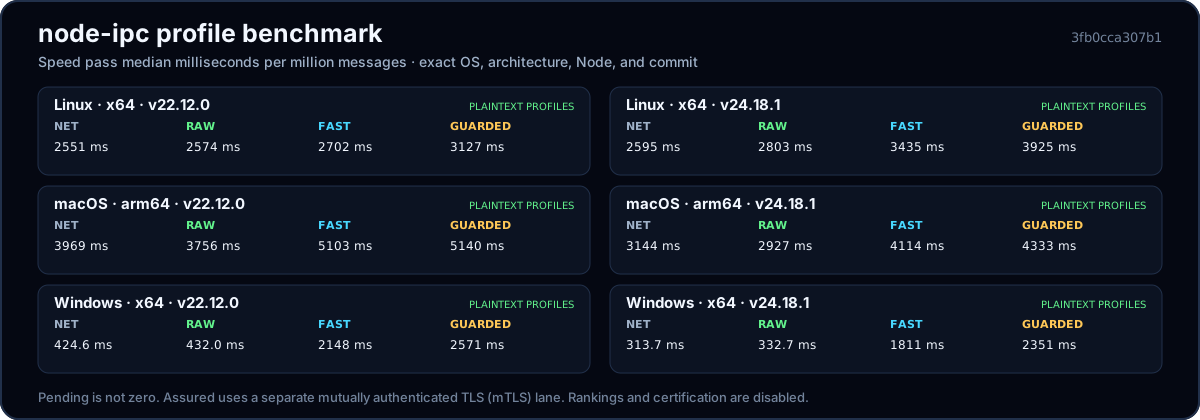
Raw, Fast, Guarded, and Assured are explicit Node.js message-path contracts. Configure one before creating a client or server; node-ipc selects the parser, receive, write, and logging handlers once.
| Profile | Per-message node-ipc work | Use when | Do not assume |
|---|---|---|---|
| Raw | Direct Buffer write/read. No node-ipc framing, JSON, envelope, name, size, timeout, or pending-write checks. | Both peers are trusted and implement a tested caller-owned protocol. | Message boundaries, validation, or containment. |
| Fast | Delimiter framing and direct JSON event-envelope encode/decode. Malformed JSON closes a stream connection or resets UDP peer frame state. | Trusted local processes need the node-ipc event contract. | Size limits, safe event names, envelope validation, timeout, or backpressure limits. |
| Guarded | Fast plus frame and stream pending-write limits, object-envelope checks, event-name rules, and incomplete-frame timeout. | Peers have authenticated identities but input still needs protocol containment. | Payload-schema validation, peer identity, authorization, replay control, or rate limiting. |
| Assured | Guarded plus an explicit event allow-list. Network peers require mutually authenticated TLS; each Unix local server endpoint must be a direct child of the secure socket root, and clients must verify ownership. Built-in Assured local service rejects Windows because node-ipc cannot prove a named-pipe ACL. | A hostile network requires a narrow event surface, verified peer certificates, and application authorization. | Certification, key management, payload policy, or complete defense in depth. |
Rust Assured enforces guarded codec limits and the event allow-list. The application must establish and verify mutual TLS, Unix ownership, or an appropriate Windows pipe ACL around the supplied transport. Open the Rust boundary →
ipc.config.parser = 'fast';
ipc.connectTo('worker');Fast is already the default. It keeps the framed event path direct.
ipc.config.parser = 'guarded';
ipc.config.maxMessageSize = 1024 * 1024;
ipc.config.maxPendingBytes = 8 * 1024 * 1024;
ipc.config.messageTimeout = 30_000;
ipc.serve();ipc.config.parser = 'assured';
ipc.config.allowedEvents = ['query', 'cancel'];
ipc.config.tls = {
private: '/secure/server.key',
public: '/secure/server.crt',
trustedConnections: '/secure/client-ca.crt',
requestCert: true,
rejectUnauthorized: true
};
ipc.serveNet('127.0.0.1', 8000);The client must likewise provide its key/certificate, trust the server CA, and keep rejectUnauthorized:true.
ipc.config.parser = 'raw';
// rawBuffer = true remains a compatibility alias
ipc.connectTo('binary-worker');
ipc.of['binary-worker'].on('data', consumeBuffer);An existing endpoint retains the handlers selected when it was constructed. Disconnect or stop it, set the new configuration, and create a new endpoint.
| Control | Raw | Fast | Guarded | Assured |
|---|---|---|---|---|
| Raw Buffer pass-through | Yes | No | No | No |
| JSON + delimiter framing | No | Yes | Yes | Yes |
| Malformed JSON contained | No | Yes | Yes | Yes |
| Object event envelope | No | No | Required | Required |
| Message + stream pending-write limits | No | No | Yes | Yes |
| Reserved/prototype-name rejection | No | No | Yes | Yes |
| Incomplete-frame timeout | No | No | Yes | Yes |
| Explicit event allow-list | No | No | No | Required |
| Verified mutual TLS required for network use | No | No | No | Yes |
| Verified owner-only Unix server root required locally | No | No | No | Yes; Windows local rejected |
Legacy payload-based socket IDs are separate from profiles and disabled by default. identifyPeer=true selects that lookup once, but data.id remains untrusted application input—not authenticated identity.
Raw or Fast can fit low-latency trusted process graphs, games, media, telemetry, and high-frequency local services. The caller owns every omitted control.
Guarded can contain protocol abuse after peer identity is established. Add payload schemas, authorization, quotas, observability, and deployment hardening.
Assured provides a narrower protocol building block. A deployment still needs its mandated cryptography, identity, key management, audit, supply-chain, availability, incident-response, and accreditation controls.
node-ipc supplies the race car. The application decides whether the operating environment needs minivan or armored-vehicle controls—and pays only for the selected path.